A Saussurean Analysis of a Contemporary Controversy
Sunday, July 26, 2009
One of the more public aspects of linguistic science of the past decades has been its opposition to traditional guidelines of what constitutes 'good grammar', which are exemplified in many style guides, such as Strunk & White, taught by middle-school English teachers everywhere, and enforced by whatever idiots devised the grammar-checker in Microsoft Word. What is at stake in this debate is both the relevant sense of the word 'grammar' and the appropriate norms of language, both written and spoken. Though a more obvious analysis would be an appeal to the 'objectivity' of modern science and the egotism and oppressive natures of professional writers and teachers, I think there is a deep connection between this debate and the paradigm shift in linguistic study brought about by Ferdinand de Saussure, often called the father of modern linguistics—though he is rarely cited anymore in this discipline.
De Saussure introduced the terms 'synchronic' and 'diachronic' analysis to describe how his analysis differed from his predecessors'. Diachronic analysis refers to what we call historical linguistics; it is the study of how language has changed over time, the historical relationships between languages—in short, the mainstay of 19th-century linguistics. 'Synchronic' analysis, in contrast, is the study of a language at a single, fixed point in time as a complete system of communication; this view of language is the basis of the structuralist project initiated by Saussure, carried on by the Russians and re-imagined by French philosophers. Linguists working in the scientific tradition haven't talked about structuralism since Chomsky gave them a new paradigm and structuralism became associated with the kind of philosophy that scientists are supposed to hate, but most linguistic work continues to be of a synchronic character.
One distinctive feature of the kinds of prescriptions made about language is that, by and large, they have long histories, stretching back to the 19th century or before. There has been no paradigm shift in this area; even new prescriptions are very similar in kind to the old. Some (source would be needed if I were rigorous) have likened these prescriptions—at least, those with no apparent basis, as myths or superstitions—and they do have a similar memetic quality. The pressures that shape them are entirely different from those that shape scientific theories. This relation to history strikes me as similar to diachronic linguistics, but the former is intensely conservative, while most scientific or semi-scientific forms of diachronic analysis are perfectly willing to accept linguistic change as normal and often desirable, as is obvious from any logical study of history. This contradiction—the emphasis on history and myth combined with the denial of the legitimacy of linguistic change—effect the distinctive character of most linguistic prescription. The prescriptivist is content with neither diachronic nor synchronic analysis, but rather fixes some point in history as an ideal (a point which inevitably varies depending on the prescription), and adopts it as a standard to judge current synchronic usage. Of course, many prescriptions have no real point in history at which usage would bear out their thesis, but most are perceived and transmitted as if they did. In any case, I think their real use in society, or one of them, is one of oppression, a syntactic or orthographic shibboleth that often masks racism or classism as education.
Essays: When Bad Things Happen to Good People
Saturday, June 27, 2009
Sitting at my bedroom window, staring out into the backyard, the cars whizzing past on the street, the thirteen year old me used to think, Gosh I know there is something of interest, and it is not in this room. This is what I usually thought moments before opening the window slowly and cautiously, quietly as to not wake up my parents, and daintily hopping out onto the street.
It is the impetus of suburban life to live in a constant state of nothingness, waiting for things to happen, rather than taking the particular thrill of a moment and using it to make something happen oneself. Living in suburbia, the mind becomes as a storm of heat lightning, silent, contained, yet raging, even if distant. We become confined and ever vigilant.
My roommate woke me up at five o'clock in the morning by sticking a piece of chicken sausage in my mouth. It was raining outside, a hot summer morning rain, very steamy. I'm older now and I live on the second floor. I have no desire to window dive these days precisely because the things I used to seek when window diving seem to find me on their own. If I'm window diving it's only into my own house.
Art is the product of a certain temperament. It should not mold itself to popular culture. But it is stupid to think that culture will become more artistic. Just as the poor thinks about money, and knows it not, in the way a rich man does, so does the artist look out his window at society.
I lived in suburbia until the age of thirteen. When we had the chance to move to the city, and the means, my family did so. I look back on that thirteen years period like one looks at a very small paycheck, disappointed by compensation.
The worst slave owners in the south were those who treated their slaves kindly. The kind souls who believed in the institution of slavery--believed that it truly stimulated the economy in a way that could not be replaced, and it’s easy to see how, during Reconstruction, one might have easily thought that to be true--it is they who we should look down upon. For the robbed their peers of exposure to the horrors of the system of slavery. Where is it that we bridge between charity and sin? If I give a poor man a dollar I am charitable. If he uses it to buy meth I am an enabler.
The problem with suburbia is that it does not allow the mind to experience the full range of action, but rather a livid range of contemplation. We spend out days wondering what life might be like if if if. The language of the mind becomes a kind of poetry, and we become spectators to our own consciousness, sitting, staring out the windows in our brain.
When I light incense I can't help but feel nostalgic.
When in the throws of something happening, as it seems to never do in suburbia, the mind’s poetic modality shuts down for a hot second. At that point we are no longer spectators, as we are in suburbia, but participants, and participants have little faculty for documentation. The bias is immense. The cityfolk, I have found, are participants, deadened to what might shock the gentle people of the mid-country. It happens, out of necessity, that cityfolk ween themselves off stimulation. It happens naturally.
This is probably why when something bad happens to us, finally, it seems very distant, whether you live in the city or in suburbia. When you retell the story and feel as though the thing which happened is a narrative, something you are relaying to someone else, it is because our consciousness is removed from the actual event. We feel as though we must tell the stories of our lives in third person. And perhaps this is why we lie about our lives so often: we want people to know, not how something actually happened, but how we experienced it to happen. This, we feel, is more truthful to the narrative of our lives. Not some backwater rehashing of actual events. Heaven forbid.
So when bad things happen to good people and they tell the story as if describing an ex lover or a dream, with a small hint of guilt or disbelief, know that it is not because what has happened to them did not effect them, rattle them, etcetera, in some profound way, but rather that it did. What is most important is that you scrutinize them the way you have always scrutinized them. This is a constant affection; and because our true perfection lies, not in what happened then, but what happens now, we ought to resist the quidnuncs of the earth, even if they are, indeed, ourselves.
Photo of the day: Driftless
Friday, May 22, 2009

The other day I was walking down the street and a man approached me and my friend and struck up a conversation. He's one of those familiar faces you see around downtown, always playing music in front of the CVS, smiling and greeting everyone who passes. From start to finish he was all smiles and high energy. It was a little disconcerting, but in an non threatening way. Near the end he guessed where my friend and I where from: "Maine and.... Ohio!"
Surprisingly, he was pretty close. It caught me off guard for a moment. "Actually... I'm from Iowa." He then went on the say that he thought that Midwestern girls are the prettiest, a sentiment I disagree with wholeheartedly. Please note that I have a special place in my heart for the Midwest, and think its a starkly beautiful place, but to say that the prettiest girls are from the Midwest, a sentiment, might I add, echoed by Jack Kerouac in On the Road , is misguided and superficial.
I began thinking about the beauty of flat, the beauty of plain, the beauty of scarcity. Since I've moved to the east coast, I've become accustomed to mountains and trees, but whenever I return home I'm always struck by the comfort I find in the wide, open skies of Iowa. An image from Danny Wilcox Frazier's amazing book Driftless came to mind. It is titled, "Shooting bottles along the Iowa River, Johnson County, 2003". I grew up near Johnson County, and I welled up with nostalgia when I was flipping through Frazier's book last falll, which I came across quite by chance one day in the library. In the picture there's a solitary, identity-less man, facing an unknown foe, surrounded by flames, and framed by trees and gray sky. The smoke, the hoodie, the framing; everything hides and obscures the truth of the situation. The beauty I find in the Midwest lies in this feeling, not in the chubby, overly processed face of a farmgirl, although I suppose that's almost symptomatic of what's under discussion.
And then again maybe I'm just trying to reject my place of birth, set myself apart (that's why I moved to Massachusetts, isn't it?). Sorry Iowa, but I quiver at the possibility of a stranger identifying me as Midwestern, I know too well what it implies and entails.
It's a love/hate relationship.
Studies in O'Connor: The Crop

Flannery O’Connor once said that when you write the South the way the North wants you to write it the critics call it realism; but when you write the South the way it is the critics call it grotesque.
Three prominent figures seem to receive most of O’Connor’s criticism in her short fiction. In chief, academics and intellectuals, particularly those of the secular persuasion, come under harsh condemnation. Intellectuals form the butt of O’Connors conception of evil/the devil, that being any intelligence that is determinable on its own terms, a cerebral force that defines its own nature, a nature that, theologically speaking, is out of one’s hands regardless. Intellectuals must be shaken, violently, from the shackles of their arrogance in order to realize their moment of grace and return to god. Secondly, O’Connor criticizes women for their pedantry, their fascination with cultural minutiae and fetish of artistic scintilla. Thirdly, children, bratty and catty, never seem to deserve the love they receive, despite their unique power to reveal the hopelessness of the convoluted plight of seculars. Those who took American Lit in high school will surly remember the noisy John Wesley, "a stocky child with glasses," and the whiney June Star from "A Good Man in Hard to find.
In a strange way O'Connor's fiction is deprication. She criticizes the three things that she most closely related to: women, intellectuals, and children, while writing about something she was simoultaneously a part of and distant from: The South. But these social slots were alloted to her, she had not say, and perhaps harbored a self-hating resentment. She had no control over her gender and surly felt suffocated as a woman living in the post WWII South. She was also an amazingly bright and well read intellectual, graduating from today’s most prestigious school for English majors, the Univserity of Iowa, being sent there on the whim of her family. And finally, and perhaps most tragically, her crippling illness forced her to forever be at the call of her overbearing mother, pigeonholing her into a role of snowballing infantilization.
In her short story “The Crop” Miss Willerton, a well-to-do literary dilettante, attempts to pound out a composition on her old type writer only to be distracted constantly by her nagging family and, most troublesomely, by her own lack of skill, which she mistakes for arch.
The story begins at the dinner table where the Willertons have just finished their morning breakfast. “Miss Willerton always crumbed the table,” the narrator proclaims in the first sentence. “It was her particular household accomplishment and she did it with great thoroughness.” The narrator goes on to describe the myriad menial tasks the women perform in the kitchen, “Lucia and Bertha did the dishes and Garner went into the parlor and did the Morning Press crossword puzzle,” interspersed with onomatopoeic expletives and catty stream of consciousness rejoinders like “As if…after having [added Agar-Agar to Garner’s Cream of Wheat every morning] for fifty years, he’d be capable of doing anything else.”
This sporadic pastiche of tasks, thoughts, habits, and exercises of etiquette perfectly sets up the tenor of the entire story, in which Miss Willerton will sit at her type writer unable to think of a subject for her stories. “That was always the hardest part of writing a story, she always said. She spent more time thinking of something to write about than she did writing.” Willerton discards subject after subject, first writing about bakers, but later deciding that baker’s were neither picturesque nor did they provide provocative social commentary, moving on to teachers, which she immediately dismisses, “Teachers? Miss Willerton wondered. No. Heavens no. Teachers always made Miss Willerton feel peculiar.” Finally Miss Willerton settles on a sufficiently incendiary muse: “Teachers weren’t timely anyhow. They weren’t even a social problem. Social problem. Social problem. Hmmm,” Miss Willerton thinks before finaly settling on: “Sharecroppers!”
The monkey mind of Miss Willerton poses an interesting postmodern problem. Postmodern literary composition often used, as a device or technique, metaconscienceness as a means of problematizing the auteur-reader relationship. The opening chapter to James Agee's "Let Us Now Praise Famous Men," for example, mediates on the perverse quality of the observer, in this case a Northern journalist, trying to examine Southern subjects, impoverished and, above all else, "dirty." Agee sits on his porch litstening to Beethoven and smoking cigarettes, thinking that perhaps he should not write the book he needed to write because he could never do the truth justice. The work itself called attention to the fact that it had a process, a conception, and an architect.
Miss O’Connor, who was writing at the forefront of the postmodernists, refused the inanity of the mere technique of metaconsciousness. It wasn’t enough. Metaconsciousness had to be delicately weaved into the plot, which, for O’Connor, was at the forefront of the problem of literary creation. In “The Crop” O’Connor satirizes her own creative process as a means of simultaneously using the postmodern device of metaconsciousness and remaining staunchly faithful to the old time tradition of plot plot plot.
“Lot Motun,” the typewriter registered, “called his dog.” “Dog” was followed by and abrupt pause. Miss Willerton always did her best work on the first sentence. “First sentences,” she always said, “came to her—like a flash!” And she built her story up from them.”In this passage O’Connor calls attention to the silly way in which Willerton comes up with her lead sentence and the arrogant academic importance to which she gives it. (The academic attention to the lead, it seems, ironically takes away from the actual process of creating the lead.) However, O’Connor also satirizes her own work, which was famous for it’s lead sentences. O’Connor also starts leads sentences with the names of her protagonists, as a point of structure. “Old Dudley folded into the chair…” (The Geranium), “After the Democratic White Primary, Rayber changed his barber…” (The Barber), and the astute reader will not forget the famous opening line to “The Violent Bear it Away,” “Francis Marion Tarwater’s uncle had been dead for only half a day when the boy go too drunk to finish digging his grave…”
O’Connor, for this and many reasons, provides and interesting subject in the study of postmodernism. She stood outside the traditional postwar writers like Bellow, Salinger and Mailer. She refused the convoluted seriousness of Hemingway and Faulkner. Her fiction recalls the works of Mark Twain more than anything else, in a time when Beat poetry ruled sound, surrealism ruled form, realism ruled content, and “Invisible Man” was the defining book on race. Her grotesqueries stand outside the beginnings of postmodernism without departing from it.
Studies in O'Connor: The Violent Bear it Away
Thursday, May 21, 2009

Eye Imagery and The Violent Bear it Away
During Mason’s first encounter with Bishop in Flannery O’Connor’s The Violent Bear it Away the narrator takes special care to point out the immense gravity in the eyes of the idiot child; the old man can only see “one spectacled eye” staring at him from the crack of an open door. Eyes stand out starkly even though they never function as an imagistic singularity.
From a psychoanalyst viewpoint this method of imagistic representation, seems chronologically fitting. For O'Connor, as many have noted, the inconsequential details of the scene stick in the mind as inexplicably vivid, even though the central horror of the experience is not missing, see the work of Phyllis Greenacre. Eye imagery also surfaces in descriptions of natural entities like lakes, moons, suns, or the dreamy sky, which Tarwater sees as “dotted with fixed tranquil eyes." O’Connor’s environment becomes a projection of impulses and fears so strong that they dissolve the ego’s power, a figureative death.
The eyes, then, act as a kind of axel for the wheel of novel’s imagery. When Tarwater burns Powderhead to the ground he hallucinates a pair of eyes wreathed in flame. Eyes also reflect certain aspects of character development. Tarwater’s inability to look at Bishop in the eye, for example, indicates his unwillingness to face his destiny. The narrator describes non-human objects with imagery of the eyes to suggest the existence of a divine power in the cosmos and elsewhere, staring from above or below. In humans, however, eyes act as the body’s vessel of God and any desire to repress this presence is expressed as a physical weakness.
The usage of eye imagery to describe elemental bodies, like lakes, suns, moons, and skies, suggests the presence of an oppressive power in nature. After being dropped off at Rayber’s house, Tarwater spends a few moments sitting on the doorstep, too scarred to enter, contemplating the eye-like quality of the stars. He cannot look directly at the sky even though “he was unpleasantly aware of the stars." Nature serves both as the hand of God and as the barometer registering Divine disapproval or benediction. This could explain why Tarwater felt so uncomfortable under the immensity of the sky, why the stars “seemed to be holes in his skull through which some distant unmoving light was watching him, as if he were alone in the presence of an immense silent eye." The sun, for example, like an omnipotent father floating in the sky, keeps an observant eye on Tarwater. The sun “watches” Tarwater. Water too becomes a physical entity that responds to Tarwater’s actions. Tempted to baptize Bishop in a fountain Tarwater stands at the edge, staring “deep into its eyes.” “I’d drown him first,” he says to the fountain—simply a reflection of his own face in the water—to which the eyes eerily reply “Drown him then."
In the same way that nature, described with eye imagery, suggests the presence of an oppressive divinity, human eyes act as mirrors, reflecting the supernatural forces already latent in a body. All the devil figures, for example, have terrifyingly bizarre eyes, whether it is the “yellow-rimmed” eyes of the ‘stranger,’ Meeks’s “soot-colored” eyes, or the neon violet eyes of the ‘friend.’ Their ocular abnormality sets them apart from the city folk whose eyes “didn’t grab you like the eyes of country people." The eyes of the old man also possess a divinity; even in death they glow “silver” and can focus sharply on something from across a room, suggesting that the eyes can live on without the body. For human characters, the acceptance of fate and the presence of God in the body cause the eyes to glimmer and glow.
Tarwater, who constantly tries to evade his fate by refusing to baptize Bishop or bury his uncle, suffers from visual blurriness, suggesting that the evasion of fate causes blindness. Tarwater physically struggles to focus his eyes in the presence of characters who have realized their destiny, like the old man. When looking at the old man Tarwater keeps “his vision located on an even level, to see no more that what was in front of his face and to let his eyes stop at the surface of that." Before burning Powderhead to the ground, an figurative act of rebellion against his fate, Tarwater’s eyes become “half-open” and “unseeing." Additionally, in a flashback during which he disobeys one of the old man’s commands Tarwater’s eyes are described as “open but not well focused." Any event or action integral to his destiny has some effect on his vision and when he resists the divine powers will push back. Tarwater finds it difficult, in effect, to look at his future.
While Tarwater’s evasion of fate causes blindness Rayber’s evasion of fate makes him incapable of looking at the spiritually grotesque. He becomes agitated staring into the eyes of the young evangelist, Lucette Carmody. She stares at him through a window, her “dark gaze” finds him, causing him to experience “a deep shock” that makes him “certain that the child had looked directly into his heart." In order to withstand the severity of the moment Rayber turns off his hearing aid, deafening him to the word of God, a figurative blindness. Rayber cannot bear to see or hear this sound. Even the memory of the old man’s eyes, full of God, disturbs him. In the following passage Rayber meditates the similarity between Tarwater’s gaze and the old man’s:
Something in his very look…seemed to feed on him. With Tarwater’s eyes on him, he felt subjected to a pressure that killed his energy before he had a chance to exert it. The eyes were the eyes of the crazy student farther, the personality was the old man’s, and somewhere between the two, Rayber’s own image was struggling to survive and he was not able to reach it. (115)Rayber still feels traumatized by the memory of the old man with “mad fish-colored eyes” (170), telling him that he must be “born again.” “It was the eyes that got me…” he reflects, “children may be attracted to mad eyes. A grown person could have resisted…Children are cursed with believing."
It is no accident that both Rayber and Tarwater possess similar weakness in the eyes. Like Tarwater, Rayber had been kidnapped, baptized, and even spent a brief adolescent stint as a fundamentalist. Even though Rayber tries to distance himself from his former identity as a potential prophet he has merely repressed or distorted his vocation. But this “vocation” is familial, it resides in the blood, and the only way Rayber can escape it is to constantly force it down with neurotic control:
The affliction was in the family. It lay hidden in the line of blood that touched them, flowing from some ancient source, some desert prophet or polesitter, until, its power unabated, it appeared in the old man and him and…in the boy…He had kept it from gaining control over him by what amounted to a rigid ascetic discipline…He knew that he was the stuff of which fanatics and madmen are made. (114)The eyes reflect this “affliction.” Carmody has accepted her vocation and so her eyes take on a fiery verve. The old man has embraced his affliction, so his eyes are lit ablaze. The fact that Rayber and Tarwater’s have weak eyes does not does not necessarily indicate their lack of this affliction, but rather the repression of it.
Rayber can repress his calling, but Tarwater cannot; as a result, his eyes maintain a glint of fire, periodically bubbling to the surface, spilling over. Something lurks, subdued, behind his eyes. He tries to contain his affliction, his destiny, his vocation, but he struggles. In looking into Tarwater’s eyes Rayber sees an emptiness, but behind that he also sees something raging, on the point of explosion, trying to pierce through the surface, bright only like a pin hole can be bright, ready to burst forth. This turmoil in the eyes is Tarwater’s conflict of interests. He does not want to baptize Bishop, yet he cannot help feeling involuntarily aroused whenever Bishop approaches a body of water. When he attempts to baptize Bishop in a hotel swimming pool, for example, Rayber notices that Tarwater’s eyes “burned as if he beheld some terrible compelling vision." Rayber also notices Tarwater trying to pull back, “exerting an almost equal pressure from what attracted him.” Here, Tarwater’s physical resistance battles the divine power dormant in the eyes. Tarwater clenches his fists trying to resist the baptismal urge. His normal sight eventually fails, leaving in its wake a divine vision: “Rayber had the sense [Tarwater] was moving blindly, that where Bishop was he only saw a spot of light." Even the woman behind the hotel desk can see the God’s sinister plan unfurling in Tarwater’s gaze, as if each of his eyes were a diviner’s crystal ball:
His eyes as they turned and looked down at her were the color of the lake just before dark when the last daylight has faded and the moon has not risen yet, and for an instant she thought she saw something fleeing across the surface of them, a lost light that came from nowhere and vanished into nothing... convinced she had not seen it, she muttered, ‘Whatever devil’s work you mean to do, don’t do it here.’ (156)Compulsion, encapsulated in the fiery gaze of the soon-to-be-prophet, overcomes Tarwater’s will to resist. The eyes then become the battle ground between Tarwater’s normal vision and Tarwater’s divine vision.
The juxtaposition of a Tarwater’s weak human vision and a strong divine vision parallels the (im)balance between his desire for autonomy and the force which compels him toward his predestined fate. “The old man had transferred his fixation to the boy,” Rayber realizes, and “there was no hope of discussing it sanely with him, for it was a compulsion." The exactitude of Tarwater’s divine vision confirms the ruthlessness of this compulsion, his eyes narrowing “so that the lake must have been reduced to the width of a knife-blade in his sight." Rayber still believes, however, that Tarwater can overcome this compulsion because—despite appearing controlled by outside forces—Tarwater can resist. He harbors an “undisguised hostility” in his body. His eyes yearn for Bishop’s baptism while his body literally “trembles” with fear, a fear of realizing a gruesome, predestined fate. Rayber must also ward off this compulsion, for he secretly desires the old man’s God sent vim and vigor. “He always felt with it a rush of longing to have the old man’s eyes—insane, fish-coloured, violent with their impossible vision of a world transfigured…[it] was like an undertow in his blood dragging him backwards to what he knew to be madness."
The narrator describes this ailment of compulsion, which apparently runs in the family, as a silence of the mind and ocular coruscation. “It was a strange waiting silence. It seemed to lie all around him like an invisible country whose borders he was always on the edge of, always in danger of crossing." The silence represents the death-like resolution that comes with ceding to God’s will. What is more, this silence becomes expressed in “the center of his eyes” as a fiery blaze. Tarwater clings to his identity as if to life; he resists baptizing Bishop as a way of eluding a figurative death. He “could have baptized [Bishop] any one of a hundred times,” the narrator reveals. However, “each time the temptation came, he would feel that the silence was about to surround him and he was going to be lost in it forever.” Rayber also senses the violent combat that rages within him, though he feels it as a compulsion to become his great-uncle. He realizes this when Tarwater gazes at him with “the eyes of the crazy student farther.” “The personality was the old man’s,” he thinks, “and somewhere between the two, Rayber’s own image was struggling to survive and he was not able to reach it." Both Rayber and Tarwater must straddle the desire for autonomy against the compulsion toward destiny.
Tarwater’s body, the manifestation of his autonomous will, is pitted against the eyes, the presence God’s control. As the body becomes lugubrious the eyes becomes powerful, and vise-versa. The brilliance of the prophet, dormant behind the eyes, comes out in Tarwater in times of physical duress. At the beginning of the novel the narrator explains how the old man would take Tarwater out into the woods, “occasionally for days,” and when Tarwater returns, weak and hungry, he would look “as if his head were still full of visions he had seen in its eyes." As his body begins to deteriorate toward the end of the novel his eyes grow fiery. Out of bodily destruction comes grace, also represented by the fact that Tarwater was born out of a wreck. Thelma J. Shinn, in her essay on the use of violence and grace in O’Connor’s fiction, explains the relationship between physical affliction and the presence of God. She argues that spiritual grotesques, like Carmody and the old man, possess physical afflictions while the secular grotesques possess spiritual afflictions. Secular grotesques “destroy the spirit in their attempts to save the body,” while the spiritual grotesques “at least sometimes are able to reach spiritual salvation through physical destruction” (Shinn 62). This inverse relationship between the body and the spirit is directly correlated to vivacity of the eyes.
For O’Connor the body cannot withstand the wrath of God. Violent acts, such as Tarwater’s rape, force characters to realize their vulnerability and that, try as they might, they cannot evade fate. For O’Connor, any idea that human life is perfectible by its own means is evil. The devil, for O’Connor, is simply man’s self-assurance and lack of humility. Before Tarwater burns Powderhead to the ground, the devil tells him: “Don’t everything you do, everything you have ever done, work itself out right or wrong before your eye?” (O’Connor 46). He says “before your eye” as if to hint “not before the Lord’s eye.” He tempts Tarwater with the prospect he has the power to fix his own situation, that it will not require the intervention of God. This section concludes with a reference to Tarwater’s prophetic blindness: once the devil incites him to set Powderhead aflame, the inebriated Tarwater becomes unable to focus his “half-open unseeing eyes." It takes an act of violence to shake Tarwater from these conceptions. Violence takes away the pretensions to power and reduces man’s body to dust, making him realize his true fragility, necessitating a complete and total submission to Christ.
Rayber never submits to the will of God, and as such he always remains a lost figure, a secular grotesque. Rayber’s final scene in the novel demonstrates the way in which his stubborn refusal to submit has turned him into an emotional cipher. Standing at his window, watching Tarwater drown Bishop in the lake, “he stood there waiting for the raging pain, the intolerable hurt that was his due, to begin, so that he could ignore it, but he continued to feel nothing. He stood light-headed at the window and it was not until he realized there would be no pain that he collapsed." Rayber’s lack of pain illustrates his severance from God; he is confined to the painless emptiness of Limbo and denied the purifying pain of Purgatory. Rayber never experienced an act violent enough to change his perception of his responsibility to God, whereas the devil’s final stand against Tarwater successfully brought him back to the holy fold. After Tarwater’s body has been completely destroyed, penetrated, and figuratively castrated, it is only then he can harbor humility and venture forth to “shout the truth.”
After he is brutally rapped Tarwater’s eyes take on new life, becoming “small and seedlike as if while he was asleep, they had been lifted out, scorched, and dropped back into his head," while his body crumbles under the pressure of starvation. “His scorched eyes no longer looked hollow or as if they were meant only to guide him forward. They looked as if, touched with the coal like the lips of the prophet, they would never be used for ordinary sights again." His will to autonomy (the body) has been destroyed, and the will toward destiny (the eyes) has been set ablaze. Out of the ashes, Tarwater triumphs forward with his new eyes. Born-again, he no longer recognizes the landscape so “familiar to him since his infancy,” which appears “strange and alien." The old man’s command, “GO WARN THE CHILDREN OF GOD OF THE TERRIBLE SPEED OF MERCY,” provoke a sensation in Tarwater like “seeds opening one at a time in his blood," as if the spirit of God had lain dormant in Tarwater’s eyes, waiting to unfurl, waiting for Tarwater to submit to his inevitable future.
Eyes in the Violent Bear it Away always seem as if they are about to explode. Like the blazing sun that chases Tarwater, or the oppressive moon that blares bright red, God is everywhere and staring down. The sky too, beating, becomes a kind of oppressive, omnipotent force. Eyes, replete with the grace of the Lord, feed off the resistant body, like a parasite. Energized with grace, eyes rest always on the point of bursting, on the point of spilling over. Grace lurks behind them; God lurks behind them. Rayber chooses to repress this ocular force, chooses to ignore its power and lead a life of constant struggle, whereas Tarwater, undergoing a cleansing act of violence, realizes just how much he needs his moment of grace. For O’Connor, those who lead a life plagued by neither compulsion nor submission are not just living meaninglessly, but malignantly. Destiny, like the eyes of the prophet, are intrinsic, very much part of the body, stuck. No one in O’Connor’s fiction can escape the fury of Christ, just as no one can fully repress the divine fury of the eyes. The only way to rid the body of its predestined fate is to kill it. Likewise, to only way to rid the body of its eyes is to tear them violently from their sockets.
Matthew Shepherd and the End of Gay Martyrdom
In ancient Greece small penises were coveted over large penises. This particular aesthetic preference, though strange to our modernized afro-fetishized culture, fit in perfectly with the characteristically Greek adoration of the beautiful boy.
Pretty boys (and their small penises) represented what could be beautiful about the more Apollonian side of human existence. The seething Dionysian, found in the expression of the Gods, ie nature, and the portrayal of animals, who, consequently had large penises, was something to be conquered. The calm, cool, collected Apollonianism of the Greeks sought, more than anything else, to subdue the Dionysian, but in a way that did not require brute force, the way Neanderthals subdued nature. Apolloniansim sought to, in effect, subdue Dionysianism with beauty, put it in a frame, to colonize nature with human brilliance.
The beautiful boy aesthetic carried on in western art for hundreds of years after. The want for big penises really emerged with the advent of pornography, which didn't exist (as we understand it today) until the Victorian Period. It is no accident that pornogprahy was created at the same time major archeological digs uncovered thousands of erotic artifacts from Rome to Pompeii. Up until that time a penis was simply enough to get you up and out. We weren't so blasé, not immured by sex as we are now. It was around this time, with the emergence of pornography, that the mode by which the western cultural apparatus viewed the beautiful boy shifted to something more sinister.
I used to date a man who's entire artistic oeuvre centered around the sinister aspects of the beautiful boy aesthetic, how it has hindered culture at least as much as it has helped it, how it has decimated as much emotional material as it had created. He thought he was cutting edge. But the main idea around which he centered his work, that being the "beautiful boy as destroyer" aesthetic, was entirely not his. Indeed this idea is quite old. It, in fact, was the precursor to European modernism. Case in point: Oscar Wilde's "The Picture of Dorian Gray."
After the ACTUP riots (oh and they were riots) during the later part of the AIDS crisis, around 1987, the "beautiful boy as destroyer" aesthetic was no longer interesting as cultural material. The pearly faces of the Stonewall demonstrators showed a much more politically involved way of being and manner of expression. With the maundering of beautiful boys and politics came the idea of the sissy boy as badass, and, consequently, queer culture, for a short while, merged with punk culture, which, for all intents and purposes, was stolen from street culture, which had been there all along (punks just gave a name to it).
The Death of Matthew Shepherd complicated things. Here we had a beautiful boy who was the victim of homophobia, tied to a fence in a Jesus like pose...the story was ripe with meaning. In demonstrations queers held up his face on posterboards and demanded justice. His face became a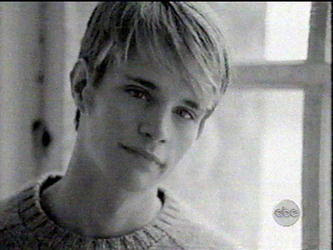 symbol for all gay justice. And for awhile we used his image ethically. But as it happens with all images, people began to fetishize his position of martyrdom. Beautiful boys essentially reverted to the old Greek way of being: they represented something already dead, something temporal and delicate, like a wilting flower, ready to be plucked. In a way Matthew Shepherd holds a cultural place that is enviable. He, like a Lancelot, died in his prime and is remembered in state of perpetual youth. Lucky him.
Yet cultural consciousness never forgets. And we cannot forget the tenor of modernism, the sinister side of things, the multiplicity of consciousness that complicates any straightforward view of any one thing. (Damn you modernism, you make life so difficult.)
This is why Gay Martyrdom is about to end. Gay culture is, like western culture, is experiencing a postmodern renaissance thirty years late. And then, it's fitting. The cynicism and reductive attitude of Postmodernism was preceded by the eclectic sixties, in which academe and art tried to get back to its roots, sampling from all over the world, experiencing a kind of cultural nirvana, a connection that we find almost comical these days. Peace and love and vegetables. Et cetera.
The peace and love for Gays is over. The contemporary sincerity, think Cascade AIDS project, SMYRC, the "we are just like you!" rhetoric of the nineties, coupled with the radical sexual questioning on college campuses in the naughts, and now it follows of necessity that gay culture will begin to explore the ineffable sides of sexuality, the maddening emptiness of queer expression. Where is our nihilism, some ask. Don't worry your pretty little heads off, I say. It's coming. And when it does, when it does, I don't think you'll like it.
What I am saying is that Gay culture is on the verge of apocalypse. Gay will no longer mean gay. Straight will be a moniker of mundane inanity. Naming is violent, but we will, as postmodernism did for art, find that it poses a satisfying artistic paradigm.
Gay culture is becoming normalized. When it does, when gays become straights, are allowed to marry "just like everyone else" then a subculture will form. Nope, no Golden Era for the Fags. No time in which we will revel in the goal we have sought so long, equality; but when we finally get what we are looking for we will suddenly realize that it wasn't all it was cracked up to be and then we must ask the really hard question: if equality isn't really what I want, then what do I want. My answer to the question we as a queer culture have yet to ask is this: the point is to experience the existential pain of the question to which there is no answer.
To quote Plath, sometimes if we are wanting many things it is because we are dangerously close to wanting nothing at all.
Literary Excerpts
Thursday, May 7, 2009

" [Janie] was stretched on her back beneath the pear tree soaking in the alto chant of the visiting bees, the gold of the sun and the panting breath of the breeze when the inaudible voice of it all came to her. She saw a dust-bearing bee sink into the sanctum of a bloom; the thousand sister-calyxes arch to meet the love embrace and the ecstatic shiver of the tree from root to tiniest branch creaming in every blossom and frothing with delight. So this was a marriage! She had been summoned to behold a revelation. Then Janie felt a pain remorseless sweet that left her limp and languid."
