Literary Excerpts: Melville
Friday, July 20, 2018
"Come, Ahab’s compliments to ye; come and see if ye can swerve me. Swerve me? ye cannot swerve me, else ye swerve yourselves! man has ye there. Swerve me? The path to my fixed purpose is laid with iron rails, whereon my soul is grooved to run. Over unsounded gorges, through the rifled hearts of mountains, under torrents’ beds, unerringly I rush! Naught’s an obstacle, naught’s an angle to the iron way!"
Literary Excerpts: Eliot
Saturday, October 5, 2013
"Go, go, said the bird: human kind
Cannot bear very much reality.
Time past and time future
What might have been and what has been
Point to one end, which is always present."
Thursday, February 21, 2013
What Ever Happened to Bohemianism?
Thursday, April 19, 2012
A disambiguation, just so we're all on the same page here:
- Bohemians are voluntarily poor.
- Bohemians share their work primarily with other Bohemians.
- Bohemians are seldom syndicated within a paradigm of mass capital.
- Bohemians believe in free love and challenge all notions of fidelity.
- Bohemians do not appear on Top Ten lists.
SCAMP: On Things I've Heard in the Sauna
Wednesday, May 25, 2011
I find it odd when people sport underwear in the sauna. It’s odd that one would enter with the intention of perspiring freely and then decide to wear something to impede it, creating laundry and discomfort. But this, I doubt, is why people cover themselves. When I see someone in the sauna wearing an undergarment I am quicker to assume that they’re doing it to conceal their genitals, for whatever reason. Of course, to conceal one’s genitals presupposes that someone else wants to look at them in the first place.
When it comes to the ethics of “checking out” other bodies in the locker room, my policy is this: to assume that my peers are not voyeurs, to let them know if I feel their behavior suggests otherwise, and to hope that they do the same for me. Unfortunately, I find that my policy pans out successfully, on average, about 20% of the time. For I have found myself in countless situations wherein I have been clearly observed and I have not said anything. But I get over it quickly. The situations that leave me with more unease are those in which I find that I am made to be a voyeur.
Last week, for example, I was sitting in my usual spot when two boys walked in and began discussing the most effective way to trim pubic hair. At first I tried not to eavesdrop, but found that in the quiet of the sauna such a task was impossible. At least, I thought, I can respect their privacy by not glaring at them. But this hope was soon dashed when one of them flipped up their towel and began demonstrating how one performs a testicular self-examination. And this was no isolated incident. The week before I witnessed a boy run his hand over the stomach of another boy, saying “Dude, how do I get abs like that?” to which the other replied, “Protein shakes and medicine balls.” When spectacle confronts me without warning, I find it hard to simply ignore.
There are, of course, those who take pleasure in looking at the male body. Even though I am One of Them, I hesitate to describe the feeling I get from observing these exchanges as “Pleasurable.” “Discomforting” might suffice; for when I am subjected to homoerotic spectacle in the sauna I am made painfully aware that my observation or participation is essentially sexual harassment. The moment a heterosexual male exposes his body in that locker room I am already guilty of lechery.
Whether it be a public sex-act or a car hitting a cat, spontaneous spectacle instantly produces an observer out of people close by. The observer must choose to either bear witness to the spectacle or resist witnessing it. Seeing as the interactions of the Leonard Center boys’ locker room bear remarkable verisimilitude to cheesy gay porn, it might behoove us to ask what observers are being produced, where, and to what ends. I am not trying to argue that Macalester’s locker room antics are “sexy” (quite the opposite, if you want to know), but rather that gay porn probably fetishizes a dynamic that arises the moment a queer body steps foot into a hyper masculine space.
The problem addressed here is not necessarily the spectacle of locker room homoeroticism by itself—the athletic male body is the standard currency of sporting disclosure, constantly on display, at work, being measured and evaluated. Clearly they are no strangers to display. The problem arises when the queer body, or any marginalized body for that matter, is robbed of the opportunity to choose whether or not he will witness something that implicates him in a relationship that carries with it potential institutional punishment.
At the end of the day, the discomfort queer people feel around straight people cannot be explained simply by the privilege of heterosexual male athletes, the privilege to freely display their bodies in spaces Made For Them. My point here is that systemic prejudice is subtle and ubiquitous. True, sometimes bigotry takes the form of an overt hate crime, but it can also take the form of a Speedo, a glance, or a “given” code of “respectful” and obedient conduct. Does this mean that all heterosexual athletes shouldn’t wear a Speedo in the sauna? No. Wear what makes you feel comfortable. Just know that the ability to freely gossip about protein shakes and your dick size comes to you at the expense of our peace of mind. If I traipse into the sauna nude, not thinking anything of it, I will soon realize that there is indeed a protocol for where to look and how to act. I should even be so lucky to step foot in that locker room, seeing as my incurable perversity poses a threat to the Step Forward campaign’s shining stars.
On Online Dating
Thursday, February 3, 2011
During my junior year a friend of mine decided to erect an OkCupid profile. She asked me to join her and I did so out of solidarity, if not a great deal of curiosity. At first the site piqued my interest. However, this enthusiasm eventually gave way to a visceral feeling of discomfort, one that unnerved me so profoundly that I had to delete my profile and could henceforth never argue in favor of online dating ever again. My friend, on the other hand, went on to find a boy with whom she’s been happily dating for over a year.
In observing my own negative response I was compelled to ask myself why I had reacted so poorly and, when my peers asked me the same question, why I would respond: “I don’t know, it just creeps me out.” It seemed unfair and disrespectful of me to reject, without good reason, a tool that has helped millions of people find a person whom they can love.
On first inspection I thought that my unease had to do with Macalester’s inability to efficiently communicate face-to-face. With the explosive, campus-wide popularity of sites such as LikeaLittle.com, the internet’s ability to open up new avenues of romantic dialog has come under fire by myself and others. What is more, as a child of a hippy mother, I accepted as an article of faith that “authentic” conversation was the only kind. However, I later found that these cherished precepts had, over the years, become ingrained as increasingly impracticable prejudices. Why do I say impracticable? Because I spend my life in front of a computer.
The conversation against OkCupid that uses flighty ideas of authenticity is about as jejune as a fear of Craigslist murderers. However, many who have dabbled in online dating will tell you that the discomfort is undeniable despite its being inexpressible. As such, I’d like to propose the following as a possible reason for why one might react poorly to the idea of online dating:
Like most other dating sites, OkCupid uses algorithms to match people based on answers to sets of questions as well as data collected from the correspondences between users. OkCupid’s goal is to stimulate a “three-way”--not a ménage à trios, but a correspondence wherein a user sends a message to his or her potential sweetheart, receives a reply, and sends a follow-up.
It is the nature of OkCupid’s algorithms to limit the number of users that are presented to you. These algorithms are constructed out of raw data gathered from OkCupid users and they can shed light on romantic trends, some of which people would rather be unaware. For instance, according to The Atlantic’s investigation of the site, all races of women respond better to white men than they should based on the men’s looks, whereas black women, as a group, are the least likely to have their missives returned, but are the most likely to respond to messages.
When asked if OkCupid intentionally tailors its algorithms to present users with racially “successful” pairings, co-founder Sam Yagan said: “Imagine we did a lot of research, and we found that there were certain demographic or psychographic attributes that were predictors of three-ways. Hispanic men and Indian women, say. If we thought that drove success, we could tweak it so those matches showed up more often. Not because of a social mission, but because if it’s working, there needs to be more of it.”
How coy. The site that claims it wants to be the “Google” of online dating cannot be
troubled with anything but codes, algorithms, and statistics. However, such staunch focus on statistical data presents OkCupid users with matches that are “compatible” in so much as they are complacent; that is to say that your “match” is only a “match” because he or she probably won’t force you to critically examine your own bigoted baggage. Because OkCupid builds its algorithms based off data collected from a society of people addled with cultural hangups, the site does more to enforce normative cultural values than it does to foster co-mingling amongst people who would otherwise sit at home and whack off.
I say, let them sit. Why do I have to be in support of a dating site created by four dudes from Harvard? Clearly OkCupid was made by rich-white people, for rich-white people, so that they can go on being rich-white, having vanilla sex and giving birth to purebred babies. OkCupid is just eugenics in hip clothing. It’s a site that recapitulates the same cultural ills of networking, the same privileged advantages afforded to us by our college degrees. OkCupid makes skirting around diversity easier. It, in effect, makes cheating easier. And if you don’t believe me, then perhaps you could tell me why the Harvard foursome thought OkCupid the next logical step after their first money making scheme: SparkNotes.
The Scamp: On Debauchery, Decadence, and Halloween
Monday, November 8, 2010
Every year a group of aging hippies throw a massive Halloween party in the secluded hill town of Montague, Massachusetts. The owner of the mansion on said estate offers, among other things, a potluck, a concert, a tree swing, a bon fire and a drum circle. This year, one of the more compelling elements was the candle-lined pathways that led to secluded areas where I found people either smoking kush or having sex.
As I watched an elderly couple scurry out of the woods half clothed I was perplexed and mildly unnerved: I thought these kinds of pagan ritual were only something about which we academics read. I looked on in disbelief at the abundance of people on acid passing joints left and right, the food and drink abounding, and the nymphs hanging from tree vines asking me if I wanted to "come play." At one o'clock in the morning however, party was cut short-as most good things are-by the police.
Why? Someone invited the kids.
They showed up around midnight with beer and brawn. As they poured in through the front gates I could almost smell the text messages heralding the "totally awesome party" spreading through electronic space like a diarrhea in a daycare. These kids did not arrive in costume. They heckled the crowd, partook of the potluck tables without contributing to it, and drank all the booze. As the sound of breaking bottles echoed ominously through the woods it became clear to me that what was once a good thing had been overrun by my own kind-snotty college students.
Normally I would be quick to support the debauchery of my fellow teenagers. They have a talent for underscoring the puritanical sensibilities of "old farts," which has essentially become a semantic stand-in for the more descriptive "bourgeoisie." I observed, that night, a mass of young people take advantage a group of aging hippies (granted: aging hippies with trust funds) and the safe space they had created for the consumption of drugs and alcohol.
Where was the disconnect? Should the hippies have Seen It Coming? Or do we hold the teenagers accountable for being %#$@-heads? And most importantly, is there a preferable mode of partying that we can cultivate at Macalester.
The short answer is, "NO."
The long answer is that there exists a conflation of debauchery with decadence that leads Macalester students astray. We overvalue the hyper-masculine mode of partying, the ones the cops can smell, and this reflects our shallow understanding of ritual. In the case of Montague, it almost felt as though a bunch of hammered jocks had crashed an X fueled love-fest, an experience the more seasoned partiers of Macalester can surly attest to.
But what exactly is the difference between debauchery and decadence? In the first place, both are connected, it seems, to nature. Pagan decadence has been a symbol of the "organic society" as far back as you want to trace it. Theorists such as Baron de Montesquieu and Edward Gibbon would argue that the organic metaphor of decadence became best articulated in ancient Rome.
Smooshing culture and nature together, however, causes major problems. When we apply "the natural" to the specifically "cultural" we get stupid teenagers: I am an animal and so I must drink and party hard enough to behave like one. After Oscar Wilde, a cultural "performer" of sorts, it became clear that decadence was the application of social customs to human necessity. Decadence is, in short, the recognition of that necessity within a universe that might smite us at any moment.
Debauchery is tragic: the drunk-kid breaking a window is essentially the fallen king, shaking his fists at the sky, realizing that he never had any control over his fate from day one. Decadence is comedic: a reconciliation with uncertainty through being fabulous(!).
Decadence, for our purposes here at Macaleser, is a far more complex understanding of "partying." While debauchery is masturbatory, decadence has a purpose in society. Nobody cares about your emotional problems, but everyone loves it when you look spiffy.
When we party at Macalester we shouldn't do it to blow off steam all over someone else's property. We party to cultivate that steam, to rejuvenate the happiness the academy vampirically sucks away. Debauchery only requires that we are sour and lonely and stupid and bitter; anyone can walk into a random party and break things, but it is the genius who uses finesse.
In closing, I'd like to point out the obvious critique that decadence is aristocratic and therefore evil. Again, what a shallow understanding of decadence, for how many wealthy, paternalistic students do you know who take it upon themselves to vandalize property? That's the true aristocratic entitlement. Decadence is just a synthetic fur coat and a box of Franzia.

The Scamp: on smoking and its regulation at Macalester College
Wednesday, October 6, 2010
The recent upheaval of anti-smoking regulations on campus has forced a few of us, smoker and non-smoker alike, to ask “why?” Why do we smoke and, as such, why are we so cynical about not being able to do so within whatever-it-is feet of doorways.
The answer to all these “whys” resides in the first cigarette. Every smoker remembers his first cigarette with fondness. This seems strange when one considers that tobacco, at first, induces nausea and dizziness. Cigarettes require that one become addicted to them before they induce pleasure.
And therein lies their mystery. Unlike heroin, ecstasy, alcohol and cocaine--all of which are rewarding from the first dose--addiction precedes tobacco's pleasure. Once hooked, each cigarette provides a small dose of nicotine that satiates the desire for itself, like a knot that constantly winds itself up only to be untied. So the question is not “why do people smoke?” but “why do people go out of Their Way to start?”
The simplest answer, meaning the one that non-smokers will give you, is that it looks “cool.”
Why, they ask, are smokers trading their health for a vacuous image? But it is not this simple and one living off mac’n’cheese might do better to interrogate his own health. There have been countless anti-smoking campaigns that attempt to do dislodge tobacco from its romance with “coolness,” yet teenage smoking abounds in ever increasing numbers.People might start smoking to look cool, but it’s certainly not why they continue. At some point you’re addicted and, as my friends say, the party’s over. You look bad. You smell bad. Your mouth tastes like tar. People continue smoking to alter they way they perceive, not to alter the way they are perceived.
I have often joked that when I quit smoking I will do it cold turkey--with the exception of cigarettes after sex, during European films or long baths, when angry, drinking, inside a Wisconsin diner, and/or, finally, in pensive solitude. Once addicted, a cigarette punctuates with pleasure the occasion you take to smoke it. Some might call it a system of “rewards.” Just like school children who make tick marks in their notebooks, counting down the minutes until school’s out, so do smokers stratify their life into sections.
There is one other constituency that also does this: prisoners.
Prisoners tick away the days with chalk on the walls of their cells and, as the theory goes, by chopping the days into perceptible units of chronometry time moves faster and less oppressively. Likewise, it is not the cigarettes themselves that bring happiness to the smoker, but the way in which they change the smoker’s perception of time. Non-smokers expereince time sequentially. Smokers experience time relatively, that is between occasions. The Greeks called the former chronos, which was is quantitative and continuous, and the latter kairos, which was qualitative through relativity.
It is not the pleasure itself that is most appealing; it is the tick of addiction’s clock and the way it structures our lives. We’re addicted to kairos, not nicotine. And this is why the patch is the most effective way to quit smoking: it delivers a continuous stream of nicotine, thereby robbing the smoker of kairos while also satiating desire.
Anyone who is paying attention feels that time is tyrannical, especially the college student. He is imprisoned in school, at home, by his bubbling hormones, his roommates, his family, his teachers, and a system that can neither understand nor accommodate him, but to which he is forever in servitude. Life moves for the college student as it does for the inmate: slowly, grueling, never ending. This is why smokers trying to quit will tell you that the days drag on, that they feel stupid, fat, and bored. For ex-smokers, the life they live is simply a dull progression towards death. Non-smokers, then, are the lucky few who were born too daft to need cigarettes.
Considering smoking’s prevalence among the working class, I would like to set aside the bourgeois paternalism implicit in these new smoking regulations. My labor is to illustrate that there is a way to persuade students to quit smoking, and that way is to make their lives more bearable. Unfortunately, I have never known this administration to be concerned with such trivial pursuits and would certainly never hold them to the task of making our lives worth living.
So the next time a smoker politely asks “mind if if smoke?” you will know that the correct response is not “care if I die?” but “sharesies?”
***
This is an updated version of this article: http://trackmangoes.blogspot.com/2010/01/how-to-get-teenager-to-quit-smoking.html
The Scamp: On Retraction Letters
Wednesday, September 22, 2010
A note to the reader: I have finally whined hard enough and the Mac Weekly has given me the column I asked for. What follows is the very first submission that may or may not actually run this week. The column is called "The Scamp" and this essay is an adapted/polished form of this older essay: http://trackmangoes.blogspot.com/2009/12/on-resentment-religion-government-and.html
ENJOIE
On Retraction Letters
There once was a man who tried to kill his cousin, a saint residing at a monastery. He attempted murder several times with such elaborate schemes as unleashing rabid animals and giant boulders. Each time, however, the saint came out miraculously unharmed. It took many subsquent attempts before the jealous cousin realized, wandering down a river road, that he was in the wrong and it was precisely at that moment that the ground opened beneath his feet and he was subsumed into hell.
Every preacher’s dream.
It took me years to realize that I had experienced similar changes of heart. Younger, I could never find them, simply because I always looked for them in the results they produced. But changes of heart don’t produce results or anything like it. Regardless, changes of heart abound everywhere, fruitless or otherwise.
For example: I once composed a collection of poems for a magazine in Oregon. When they received the submission they said that, on top of being poorly written, the poems were lewd. In the nights following this dismissal I fantasized about the editor sending me a retraction letter that read something like this: “Dear Jens, I have never understood the complexity of the human spirit until I read your work. Please forgive me for everything I’ve written. By the time you read this I will be dead.”
And that, of course, is the only letter a writer ever wants to receive.
Unfortunately no letter came and, taking their critique to heart, I changed my hobby from writing to photography, a passion that ended in a similar fashion—with someone telling me I was bad at it. From the wreckage of photography came film, from film dance, and from dance I returned writing, back where I had started.
Everyone changes their mind all the time to no particular end, and if this comment seems jejune to you it’s only because I feel as though I have little to no explanation for the anti-climatic ending of the following story, one of my favorite stories of a change of heart, one that involves our very own Mac Weekly.
In 2008 I transferred here from Hampshire College, where I had been writing a column for their newspaper, The Climax. Thinking highly of myself I asked the newspaper staff at my new academy if they wouldn't also give me a column. They said that they’d consider it, which in the writing world--I think I’ve ascertained--means “piss off.” But I insisted, so they asked me to put my money where my mouth was and submit a prototype to be run in the opinions section.
What resulted was a single article that, according to the Mac Weekly website, attained the highest readership that week. It was entitled “Sarah Palin is a Feminist.” A couple days, three angry girls, and one death threat later I asked the staff if that was the kind of thing they were looking for and they told me I’d be better off writing crosswords.
That was when I peevishly decided to become a wine enthusiast.
I never did fantasize about an apologetic retraction letter from the Mac Weekly, but I am immensely thankful to the latest staff members for allowing me to have the masturbatory, pleonastic column I asked for all those years ago. With that in mind I would like to invite the Macalester Community to partake in “The Scamp,” a bi-weekly box of words about which you are bound to have mixed feelings.
Serial Fiction: Bedroom Politics Part 2
Thursday, August 26, 2010
Earlier that day Bruce had been sitting in a cafe reading Justine when a classmate approached him (an obese socialist who loved to talk about metaphysics and wear tee shirts, on which were vaguely creepy sayings referencing a mental illness [schizophrenia perhaps] which, of course, he did not have) and asked whether or not he was going to vote.
Bruce laughed. "Oh," Bruce replied, taking his coffee mug in his hand and tilting it forward, only to find that it was empty. "I guess I forgot that that was today." The fat philosopher laughed and stood in the middle of the cafe twirling his hands in the air and spitting all over Bruce's table, going on and on about how a society free of coercion would not need the right to vote. Bruce took this to mean that a citizen could simply intuit a leader. As the boy spoke the heads of the people in the cafe turned like wind vanes on a balmy day. Bruce's brow began to furl.
The boy's diatribe ceased when he announced, loudly, that he was going to take a shit. He retreated into the cafe's bathroom, not having bought anything and Bruce seized the opportunity to get up from his table and head to class early. As he exited the cafe, ringing the bell on the swinging screen door, he looked back in through a large glass window at the table where he had been sitting, at his empty white coffee mug, and at the expression of the woman who was sitting next to the bathroom on her Macintosh laptop: it was one of distress.
After he left the cafe, Bruce ambled past the church and noticed a sign on the window that read "VOTE NOW!" He stopped on the sidewalk, holding his copy of Justine close to his breast, and starred at the sign. He could see his own reflection in the window, and past it several old people with graying hair and coke bottle glasses sitting behind a table while people from the adjacent neighborhood milled about filling out forms and sliding them into red, white, and blue counting machines.
It was at this time that Bruce caught an unpleasant odor that upturned his nose and caused him to look behind himself. The fat socialist was walking towards him, taking tiny steps with his thin legs that jutted out from his body like toothpicks from a potato. Not owing to anything, Bruce entered the church and decided to vote.
In Memorandum: Wren
Friday, August 20, 2010

Studies in O'Connor: adolescence
Wednesday, August 18, 2010
A diamond in the rough:
The reality of death has come upon us and a consciousness of the power of God has broken our complacency like a bullet in the side. A sense of the dramatic, of the tragic, of the infinite, has descended upon us, filling us with grief, but even above grief, wonder. Our plans were so beautifully laid out, ready to be carried to action, but with magnificent certainty God laid them aside and said, "You have forgotten -- mine?"
Scribbled in a notebook O'Connor kept during her first year of college, about two years after the death of her father. She was seventeen.
Serial Fiction: Bedroom Politics Part 1
Monday, August 16, 2010
Bruce sat on the edge of his bed in his dimly lit room with his head in his hands and no pants on. The girl was laying back on a pillow. She picked at her nails and periodically reached her arm in a strange contortion behind her body in order to position the overhead lamp clipped to the bed frame to point towards her hands. She had to, at least, be able to see them.
"I don't really know what happened," Bruce said finally, running his hands through his hair.
He turned to face her, but she promptly turned off the light and rolled over onto her side with her back facing him.
Events
Sunday, August 15, 2010

A Collection
Friday, August 13, 2010


Fiction: The House on Corsair Boulevard
Sunday, May 9, 2010
The following is an old excerpt that was cut from my novel, "A Shibboleth," which, god help me, I will finish this summer.
The next day Lara Anne saw India with both of them, and more. It had been dark--the sun hiding behind a graphite colored blizzard cloud. No matter the weather, they were all standing outside the dormitory building, smoking and talking, talking so loudly that their words could be heard on the top floor of the large brick structure by students trying to study, gritting their teeth at their desks and asking their roommates why chivalry was dead. The only sound that was louder than the sound of their yapping was that of the windows slamming shut.
And there was a girl also. Smoking also. She was just as skinny as she remembered Brock to be, though slightly shorter, with dark hair, cut in strange and violent angles. The makeup around her eyes was applied thickly and with a hand that Lara didn’t want near her face, applying makeup or otherwise. She wore a small pencil skirt with brown natty stockings. They jutted out from the bottom hem of a very large, very thick wool sweater. The top hem of the sweater hung down below her collarbone, exposing her clavicles, which stuck out like mole holes in a soccer field. She looked like a molting bird. She stood out from their crowd as she ambled round and round them, circumambulating the clique, with an expression of disgust plastered to her face.
It was a girl she had often seen before. She even visited her house several times. She was a drug dealer. She dealt drugs to freshmen, who bought marijuana mostly and synthetics on special occasions. She was a drug dealer and her name was Sylvia. She lived in the dorms, Lara saw her there sometimes after classes, but her boyfriend, Brock, lived in a house off-campus. The house may have well of been her house too because, though she lived in the dorms, she didn't, as she insisted, live there. She lived at the house on Corsair Boulevard.
The house on Corsair Boulevard was privately owned. It backed up against a giant concrete wall. Behind the wall was a freeway that seemed to cut the expansion of the neighborhood instantly. The house was at the end of street, in a cul-de-sac with some trees. Cheap grey siding ran around it. Every thin pane of glass around the sun porch was cracked. A set of crumbling concrete stairs led up the front door, which was disproportionately gothic looking with it large brass knocker that hung in the teeth of some hideous gargoyle.
The last time Lara had been to the house on Corsair Boulevard there she had gone with India and left alone shortly thereafter. Inside the house a brown carpet expanded from their feet to the living room, where Sylvia sat, wearing a small cotton tank top with ribbons for straps. Behind her was the doorway to the kitchen, where the sound of sizzling onions could be heard. India and Lara sat down at the large dining table. India set her brown lather bag near the Sylvia’s foot. Her toenails were painted. Three guys in tight jeans and clever T-shirts sat on the couch, slumped down with their hips practically higher than their heads. “Indie Indie Indie,” Sylvia said from the table.
“Sylvie Sylvie Sylvie,” she replied. India sat down in a chair next to her. Lara got an uneasy sensation, like there was a tension she couldn’t feel but knew was there. So she ambled into the kitchen where she thought she might feel safer or perhaps get a glass of water. What she found was not a glass of water, or anything like it. She found Brock standing at a stove with a frying pan in front of him, sautéing onions. He stood there with his hands at his sides. Onions burned on the sides of the pan as if they had been there for a long time, as if someone had forgot about them. But how could Brock forget about the onions if he was standing right there? Lara stood in the doorway and watched him.
“Onions cooked?” she said. Brock turned around and looked at her with vacant eyes, as if he had been blinded by something but knew she was still there.
“Huh?” he muttered. “What? Yeah. They’re cooked.” Brock was wearing a pair of baggy jeans that clung to his hips with a leather belt and a bright green vest with no shirt on underneath. He turned his head back to the pan. “You’re India’s friend,” he said starring at the onions.
“Roommate,” she corrected. She paused for a moment and corrected herself. “Well. Housemate.” They hadn’t shared a room since sophomore year.
“Whatever.” Lara heard a noise come from the living room and turned around. One of the boys slumped on the sofa had got up and was bouncing up and down on it, like a child on a king size mattress. When she looked back at Brock he had dumped all the onions onto a plate. He sat down on the floor, cross-legged, and started eating the onions with his hands. “Want some?” he said, looking up at her.
“Sure.” Lara walked over to him and they sat down and ate the onions.
“Whose side are you on?” he asked. Lara starred at the piece of onion on his chin.
“What?”
“I said whose side are you on?”
“Oh. That.” Lara turned back to the dining room but she couldn’t see India. “I don’t take sides,” she said. “I’m just here to observe.”
“Observe what?”
“The, um. I don’t know. The.”
“The freaks?”
“No that’s not really what I meant.”
“It’s kind of what you mean though.”
“No.”
“It’s fine.” Brock got up and spooned more onions onto his plate. “Do you eat meat?” he asked.
“Yes.”
“Do you want some ham?”
“Sure,” she said after a moment of hesitation. Brock sat down in front of her again. This time, in addition to his onions, a chunk of bread sat atop the plate with a slice of ham draped over it. Brock broke the bread in two pieces and put the ham in the middle. He squeezed it together and took a bite, tearing the bread away from the chunk the way a cat chews meat off a bone. Lara couldn’t take her eyes off his nails, short, jagged, and dirty. On the corner of the thumb she thought she could see a spot of green, where it had been painted weeks earlier. He shoved the sandwich into her face and she took it up and bit in to it. The meat was salty. The bread was slightly stale around the edges and was so hard it nearly cut into the sides of her mouth. “Goob,” she said finally. She had meant to say “Good." A piece of dried bread hit the roof of her mouth and she could taste blood on her tongue. She winced and Brock went on eating.
“Lara,” a voice said from behind. It was India standing in the doorjamb. Her head hung like a jacket on a hook, her hair in front of her eyes. She looked as though she might tumble on top of Lara and Brock, splayed on the kitchen floor, sending the onions, the ham, the bread flying into the wall, and the plate too, shattering into several large, sharp, ceramic pieces. But as India stood there, her hands just caressed the edges of the doorjamb, as if the only way they could hold her up was by caress. The she laughed. She smiled. She leaned forward like a trapeze artist, grabbing onto the frame and leaning forward. A piece of her hair fell forward again and then back onto her face. It got stuck in her mouth and just hanged there. She had a single braid amongst all the other hair that had a wooden bead fastened to it. The strand hung toward the floor like a pendulum, swinging. “It’s all done,” she said. India looked at Brock who had not looked up to see her. Her lips slightly parted, as if she was about to say something, but instead she stood up and headed purposefully towards the front door.
Lara got up off the floor, wiping the crumbs on her pants. She looked back at Brock on the floor, bovinely swinging his jaw. “Thanks for the food,” she said. He nodded and looked up at her. His eyelids hung low. He fluttered them for a moment, then opened them again as if Lara had appeared in the door for the first time.
Outside India was trying to light a cigarette underneath a streetlamp. She had slid her jacket on her shoulders. As she lit the cigarette her elbows raised and brought the hem of the jacket above her blouse. Under her blouse was an undershirt. Underneath that was a line a persimmon colored line of flesh running around her stomach, started and ended by her belly button poised in the center, like a diamond on a ring. India lit the cigarette and lowered her elbows. She blew a thick plume of grey smoke that rose up to the streetlamp. “Ready?” she asked.
Lara nodded and walked toward her. “Yup,” she said, sliding her jacket on over her arms. “Brock is strange,” she noted.
“Yes. He is very strange,” India said looking down at the sidewalk.
“I see him and Sylvia around together more often,” she added. “Just the other day, outside the dorms. She was wearing this cotton sweater.”
“That’s my sweater,” India said suddenly.
Lara paused a moment and frowned her eyebrows. “Wait,” she said, holding up a finger. India took a long drag of her cigarette and exhaled. As she looked up at the lamp, the light flooding over her face, she blinked several times. Lara opened her mouth, the words coming up out of her throat, but getting stuck there. It was like holding in vomit after drinking. She pressed hard, and tried not to let the words pop out, because she already knew the answer, but by the time Lara had uttered the words, “Why would Sylvia have your sweater?” it would be too late to have realized that India had been crying.
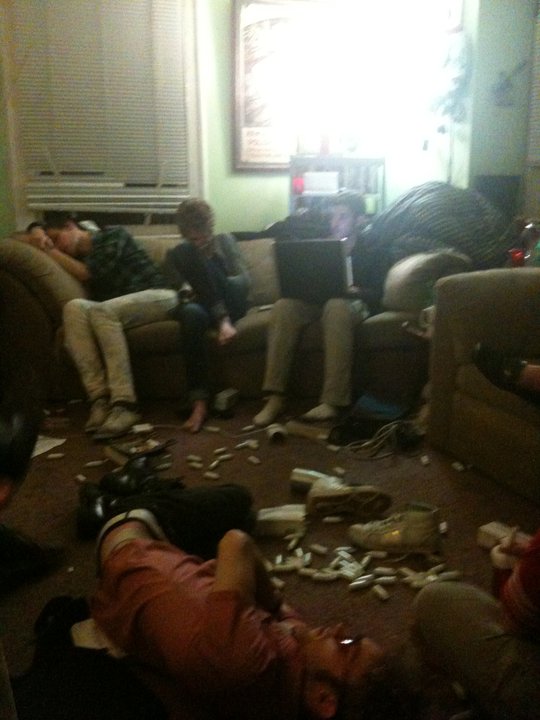
Kids at the Wheeler House, St. Paul, 2010.
Sexism Revisited
Thursday, April 29, 2010
It's going down. This Wednesday. High noon. Ethan Rutherford's Fiction class will engage in a kickball game against Peter Bognanni's screenwriting class. Who will come out on top? Who's penis is bigger? TUNE IN NEXT TIME TO FIND OUT!?!
Is it wrong to participate in this gross display of masculinity? Probably. Does that make me want to do it more? YOUBETCHA. Who will I fight for? Hollywood, obviously.
The last civilization to worship female powers was Minoan Crete, a civilzation that, ironically, fell to natural causes and, most likely, the invasion of a more technologically sound empire. Beyond this, there is not a shred of evidence supporting the feminist fabrication of "Matriarchy." There has never been one, anywhere, at any time.
I still marvel at the intensity of a woman driven by obsession. Ann Radcliffe. Emily Dickinson. Cleopatra. And I always find myself seeing it more readily in men, perhaps due to my sexual taste and the lens it affords me. While the canon seems to paint a picture of a male propensity towards that sadistic drive for art, one cannot help but remark that when such a drive manifests in women--that self-mutilating derangement which, in its alternate forms of crime and ideation, is the disgrace and glory of the human species--it always bubbles up in a more interesting way than man could ever muster.
Someone once said that there was no female Mozart because there was no female Jack the Ripper. They had obviously never heard of Aileen Wuornos.
Photos to be posted from the kickball game at a later time.
Encounters with Box Wine
Tuesday, April 27, 2010
It was only a few days before I would get out of school and head on a month long endeavor of couch surfing that I found myself in an empty dorm room holding a bag full of wine, removed from its box, above the head of the editor of my school's newspaper. The night had been a long one in which I discovered that a slushie from Super America could most efficiently mask the taste of gin and that, yes, sometimes there really was a worm at the bottom of the tequila bottle.Days shy of 45 years after he patented the idea of wine in a box, Australian winemaker Thomas Angove has died at the age of 92.
Angove was also the first winemaker in Australia to use stainless steel for the storage of wine in bulk, in addition to introducing new varieties of wine grapes to his home continent.
Blacking out is a peculiar phenomenon.
Fiction: Saying the Shema
Thursday, April 22, 2010
David sat on the edge of the bench staring at the sidewalk with his chin pressed tightly against his chest. The wind whipped pieces of his hair into his eyes and onto his cheeks like pieces of leather being slapped against the flesh. A crumpled piece of sandwich paper sat next to him on the bench, moving slightly, a half eaten pastrami on rye within. David's cell phone, a chique thing so thin it looked as though one might be able to break it with two fingers, was open in his hand, a message across the screen from one of his friends who had been arrested the night before.
There had been a protest outside of a factory up North. Students from David's school had gathered there. They were killing people, not directly, David told those who asked, but indirectly, yet it was murder nonetheless. Murder or something like it.
Not an hour before David sat on the bench he had been standing in a line to get a sandwich from a cart that passed by the school every day at noon. While he stood there a girl had come up to him, flipping her hair and licking her teeth, asking him how the protest had gone. "Yes, fine," David told her, and she laughed slightly and asked him if he wasn't aware that they had all been arrested. "Yes," David said again, "I was there." She told him that she was glad that he wasn't arrested, though she couldn't imagine how on earth he got away. "It just wasn't worth it," he told her, "I've been arrested before." "For protest," she would ask with a smile and he would nod and she would tell him that she thought the police treated actual criminals with more respect and he would agree and say that activism was a tough business and she would laugh and he would forget what he had just said and purchase a sandwich from the man with the cart.
"What'll it be?" the sandwich man would ask him. The girl, standing behind and adjusting the straps of her purse, would laugh and say that she always went for the pastrami. David would order the pastrami even though he had promised a week ago that he would take a break from meat eating. And the sandwich man would mumble to himself in a breathless way something while he spread the mustard across a slice of white bread with a broad silver knife. David would lean in closer, opening the folds of his wallet, pulling out money, but really trying to hear what the man was mumbling.
It was when David handed the man a 10 dollar bill that he realized the man was saying the Shema, mindlessly reciting it under his breath, smiling the whole time.
The man opened the cash register and the sound of the bell drove David into a hot spell. No longer able to shove the change into the pockets of his snugly fitting jeans, David would throw the remaining change into the man's tip jar as the girl behind him stepped up and started to recite her order.
"Did you hear," she would tell the man. "They were all arrested last night."
Squirrels came up to the bench, eating pieces of lettuce and pastrami that had fallen at David's feet. The girl was sitting somewhere off in the distance devouring her sandwich. From his bench David could see the white strings of her headphones hanging out of her ears like a doubled headed tapeworm, moving, writhing, going deeper and deeper as she sat. The phone was still in his hand, frozen there, as if he were about to drop it on the sidewalk. His lips were moving as if kissed by a hot coal.
David was trying to recite the Shema but couldn't remember the words.
Holiday Post
Tuesday, April 20, 2010
"The amount of money and of legal energy being given to prosecute hundreds of thousands of Americans who are caught with a few ounces of marijuana [1 ounce = 28g] in their jeans simply makes no sense - the kindest way to put it. A sterner way to put it is that it is an outrage, an imposition on basic civil liberties and on the reasonable expenditure of social energy."
-William F. Buckley
It is traditional for Buddhist monks the shave their head on the quarter moon, a day of cleansing and renewal, devoted to the deity Vajra Satva. However, in a bout of laziness, I asked my Tibetan tutor at the monastery at Mirik if this was necessary. He responded by saying that if you have trouble remembering to shave your head on the quarter moon then you should try to do just that, but if you always feel compelled to shave your head on the quarter moon then you should try your best to shave your head when you feel like it.
So today I implore you to take a moment of self reflection, of reconsideration. If you are an avid marijuana user, step back and try to remember why you started in the first place. If you feel your children are at risk of becoming stupid, why not step back and try to remember that they could out-Facebook you in any state of mind. If you worry about "gateway" drugs, try to remember the things you did you feared at first. If you feel you have friends with whom you might never smoke, reconsider. If you feel you have friends with whom you are high more often than not, why, isn't today the best of days to take that sober walk? down the street and through the air, catching whiffs of the smoke plumes as they pass under your nose?
The sober moo about purity. The hazy moo about that state which one might define as "chill." But what are we to do with the man in between: a cow who barks, not knowing what is expected of him.

